04Jun'25
Environmental Forum Discusses the Role of Youth in Climate Change Resilience
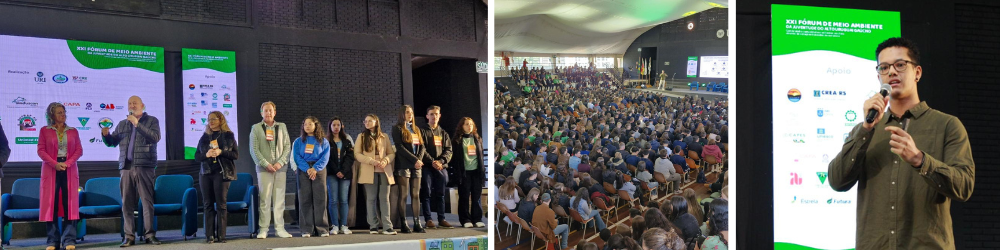
Following an educational process grounded in the principles of environmental education, URI Erechim hosted, on June 4, the 21st Environmental Forum of the Youth of Alto Uruguai Gaúcho. The central theme of the event was the role of youth in building cities and communities that are more resilient to climate change.
The Forum follows a participatory methodology and is structured in three stages. The first stage, known as the Pre-Forum, involves an exploration of the theme within schools; the organization of school-based forums; and the preparation of short courses, roundtable discussions, and dialogue circles for the Forum Day. In the second stage, on the Forum Day itself, the event takes on a regional character, welcoming youth representatives from all participating schools to discuss the theme and define intervention projects. The third stage comprises the Post-Forum, which includes the development and implementation of intervention projects, based on the fundamental premise of data generation as part of citizen science activities, aiming to empower young people, teachers, and community members as active producers of knowledge.
On the day of the Forum, more than 1,300 young people, aged 15 to 19, from 45 municipalities linked to the 15th Regional Education Coordination Office, gathered for the event. The Forum was organized by the Environmental Education Laboratory of URI Erechim, affiliated with the Graduate Program in Ecology, with the support of students from the Biological Sciences, Nursing, and Pedagogy programs, students from the URI Basic Education School, the Pedagogical Sector of the 15th Regional Education Coordination Office, and the Municipal Council for Environmental Protection of Erechim (COMPAM).
The opening lecture was delivered by researcher Rafael Damasceno Pereira in the University’s Events Hall, focusing on youth leadership in the construction of communities better prepared to face climate change.
During the morning, three simultaneous roundtable discussions were held, addressing the following themes: “Agricultural Resilience and Adaptation to Climate Change,” “Health Protection in the Context of Climate Change,” and “Experience Reports.” Participants selected their preferred roundtable at the time of registration.
In the afternoon, all participants attended the roundtable entitled “Nature-Based Solutions in Addressing Climate Disaster Risks,” which deepened discussions on sustainable and adaptive strategies to confront climate challenges. Subsequently, 30 thematic dialogue circles were held, with each young participant attending one. These spaces aimed to foster dialogue and the collective development of practical proposals to strengthen resilient communities.
At the conclusion of the meeting, the main ideas discussed in the dialogue circles were presented, and commitments to be undertaken by the participating schools were defined.
Later in June, the youth will engage in the third stage of the Forum, involving the design and implementation of projects that adopt Nature-Based Solutions (NbS) to support the adaptation of territories vulnerable to climate change.