07May'25
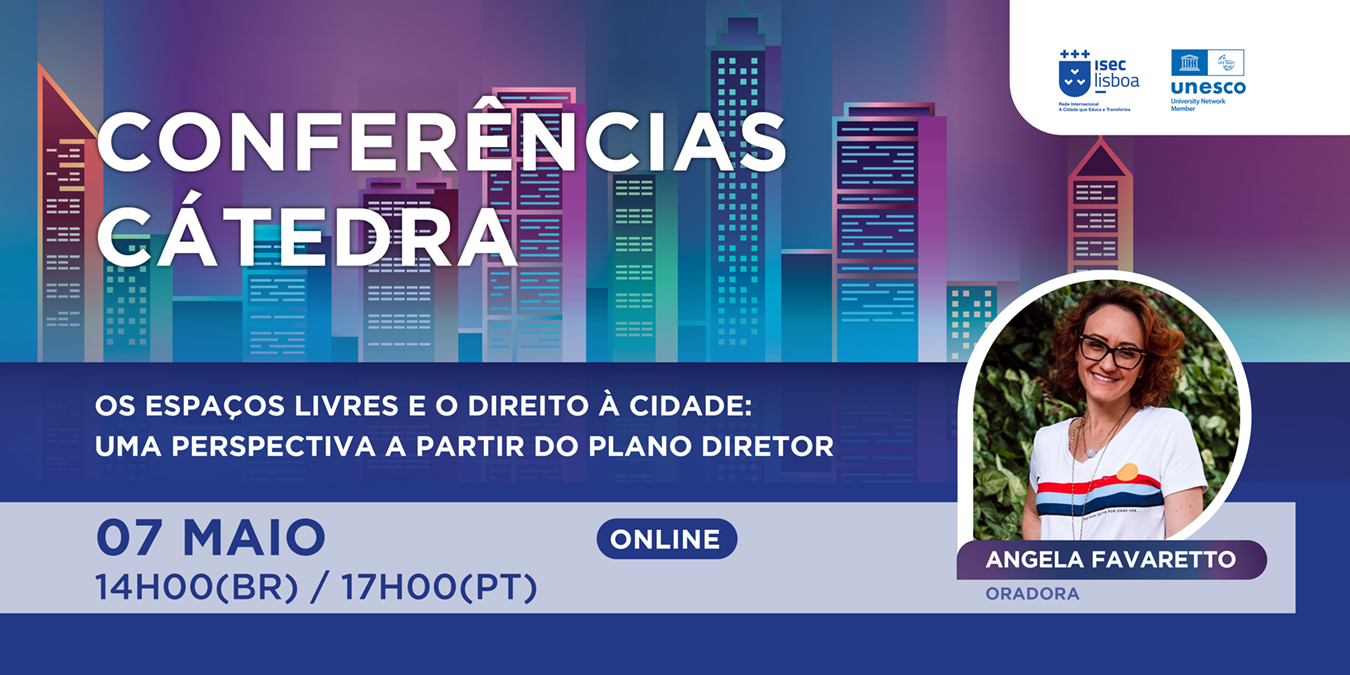
Open Spaces and the Right to the City: A Perspective from the Master Plan
Speaker: Angela Favaretto. 7 May 2025 - 2 p.m. (BR) / 5 p.m. (PT)
Since the earliest cities, urban spaces for public use, such as streets and squares, have been important. This is where daily life actually takes place, where people meet and engage in commercial, cultural and social exchanges; it is also a space for leisure, sport and recreation, as well as for mobility. It is also in these spaces that nature is present in cities, providing multiple services. Cities have changed a lot throughout history and have had to absorb a population that is still growing worldwide. In Brazil, this urbanisation process happened very quickly, without cities being prepared for it. In somewhat simplistic terms, we have a scenario of disorderly urban growth, a discontinuous urban fabric, populations vulnerable due to occupation of risk areas, socio-spatial segregation and economic disparities. Land subdivision has been the main form of urban space production, mostly by private initiative, governed by real estate capital. The reality has been one of an elite inhabiting wooded urban spaces, with large plots and wide roads well equipped with infrastructure, close to the waterfront or parks and squares, and, on the other hand, a large population contingent inhabiting the peripheries. These have plots, housing and road systems of minimal dimensions - narrow roads without trees - devoid of green spaces and leisure areas, far from the centre and parks, and with poor infrastructure. In the current post-pandemic era, as we experience global warming and climate change, the presence of nature in the city has been highlighted as essential for multiple ecological and human functions, such as: reducing social inequalities, decreasing rates of violence and stress, benefits for the nervous system and the circadian cycle, for thermal regulation and water control. This raises the question of the population's right and access to free spaces (understood as those for public use). In this context, the Master Plan presents itself as a tool for implementing the City Statute, as a legal instrument capable of structuring a System of Free Spaces and placing collective interests above private ones, thus fulfilling the social function of property.